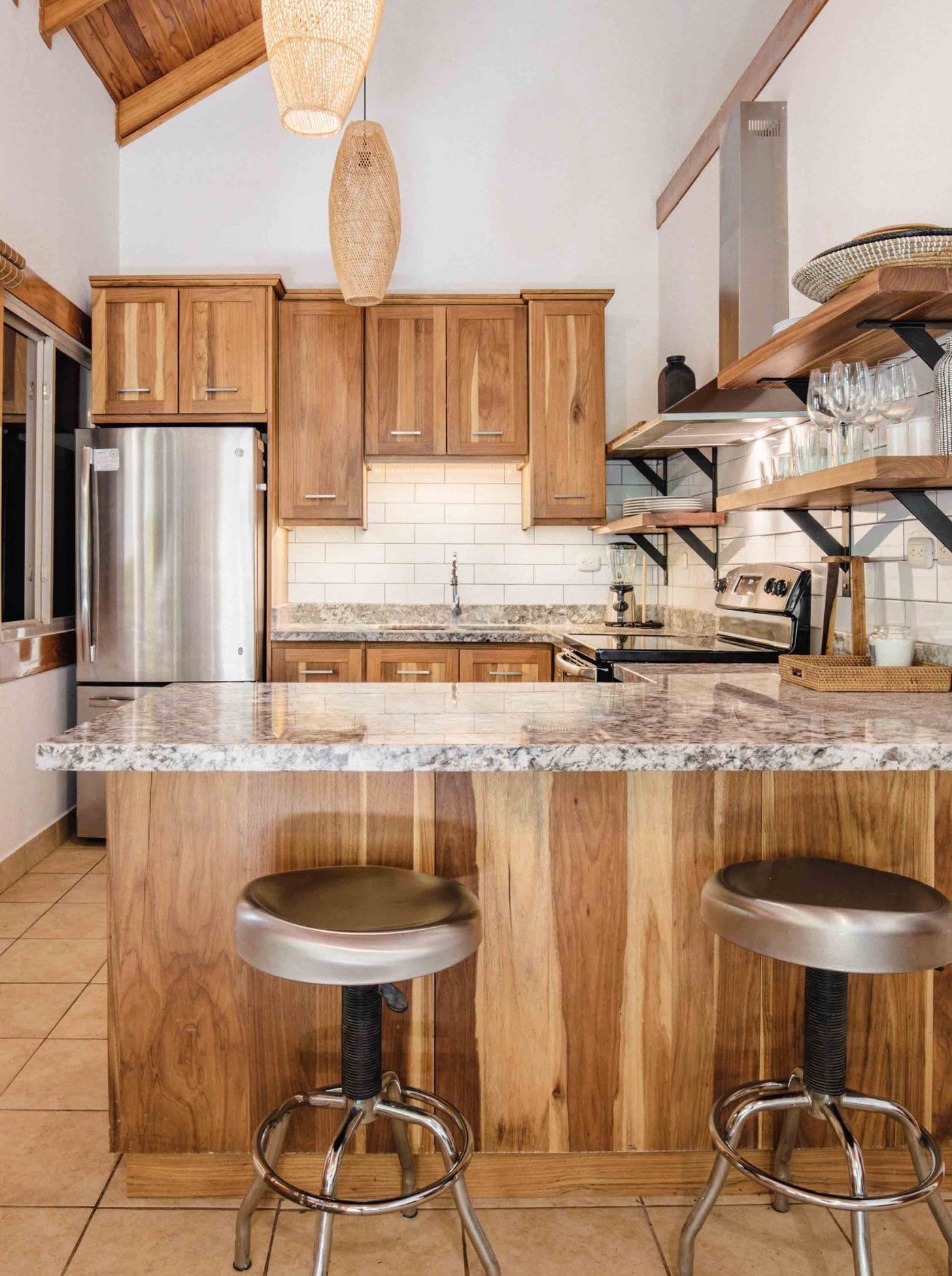
What we mean by a custom kitchen
Every cabinet, drawer, and shelf is made to measure for the room — designed with you, built in our woodshop in Tilarán, and installed by our own team. The layout follows the room rather than a catalog of standard module sizes. We build kitchens for private residences and boutique hotels across Costa Rica, from the Central Valley to the Guanacaste coast.
The kitchen is solid hardwood throughout: the cabinet boxes, the doors, the drawers, and the shelves. Never veneer, never MDF. Two of our recent kitchens show the range. Playa Guiones 506, in Nosara, is built entirely in solid Laurel with granite counters. Jacamarca, in Escazú, is painted a deep navy over solid wood, with Laurel open shelving, brass hardware, and a quartz waterfall island.
Choosing hardwood for a humid coastal house
Before species, drying. Wood that goes from a sawmill into a coastal house moves, and in a kitchen that movement shows up where you least want it — in doors and drawers that have to keep closing true for decades. Every board we build with is sustainably sourced, kiln-dried in our own kiln in Tilarán down to 8–12% humidity, and treated against pests before it becomes cabinetry. Indoors, properly dried hardwood does well in coastal homes.
Laurel and Cedar
These two carry most of our kitchen cabinetry. Laurel is a warm, honey-toned tropical hardwood; it is the wood of the whole Playa Guiones 506 kitchen and of the open shelving in Jacamarca. Laurel and Cedar give the same solid-hardwood construction as our slab woods at a gentler price, which matters in a kitchen, where the amount of wood adds up quickly.
Teak
Teak is naturally rich in oils, which makes it the most moisture-resistant of the woods we use and famously stable through humidity swings. It is dense — roughly twice as hard as Guanacaste. Plantation teak boards are narrower than slab woods, so teak panels are built from several boards joined together.
Guanacaste and Cenizaro
These are our slab woods, chosen for figure. Guanacaste is warm golden brown and light for a hardwood; Cenizaro is darker, with chocolate heartwood and a sharp line of pale sapwood, and it is harder. Both can go into a kitchen. The guide to choosing wood covers the honest trade-offs between them.
Solid-wood cabinetry vs. imported flat-pack
Most imported flat-pack kitchens are built from particleboard or MDF faced with melamine or laminate. They have real advantages: they arrive quickly, and they cost less up front. The trade-offs appear later. Board edges that take on water swell and do not come back, and fixed module sizes leave filler strips wherever the room does not match the catalog.
A solid-wood kitchen starts from the room instead. Every run is sized to the wall it sits on, every box is the same solid hardwood as its door, and wood that is damaged can be repaired and refinished where a laminate panel has to be replaced. It takes longer and costs more than flat-pack. It is also a kitchen built once.
How a kitchen should feel
We take how a kitchen feels as seriously as anything we build — in the end, more seriously than how it looks. You open its drawers and doors many times a day, and that is where a kitchen earns its keep.
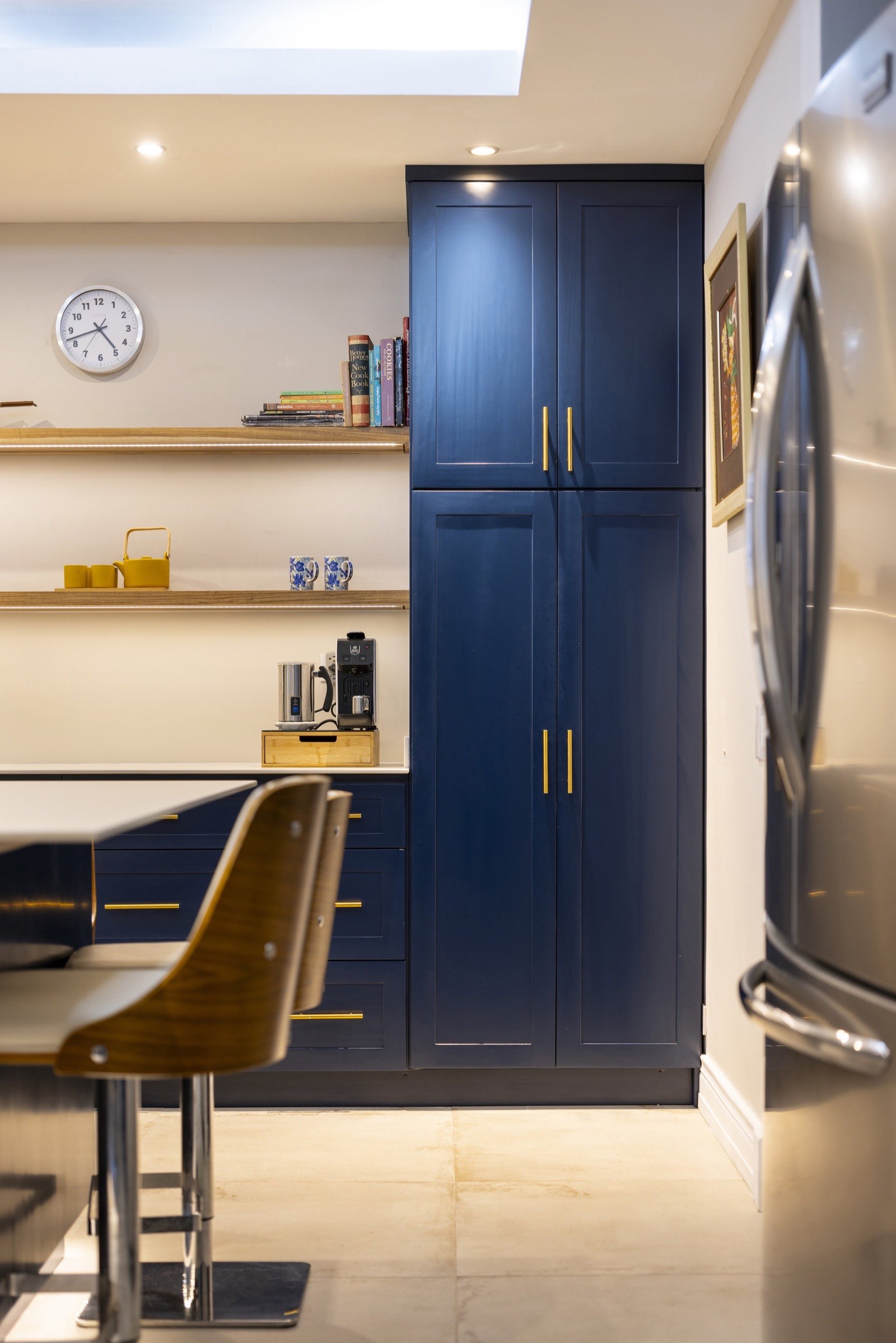
So the drawers run on concealed runners, out of sight, and every drawer and door closes on soft-close hardware. Drawers extend fully, so the back of a deep drawer is as easy to reach as the front, and pull-out storage and dedicated space for appliances are planned into the cabinetry from the first drawing. None of it shows in a photograph. All of it shows the first week you cook in the kitchen.
From first drawing to installation
A kitchen follows the same path as every commission, with more measuring. It starts with the space: an architect's drawings, a floor plan, or a site visit. From there we design the layout — cabinet runs, island or peninsula, storage, and where each appliance lives — and choose the counters and hardware with you. Our recent kitchens pair the wood with quartz or granite.
The quote is a written spec sheet, itemized unit by unit: upper cabinets, drawer bases, open shelving, a pantry tower. Each line includes the wood, fabrication, finish, and hardware, and the 13% IVA sits on its own line. Installation is confirmed once the list of units is final. Nothing is built until you approve the design.
Most of our kitchens take 10–14 weeks from approved design to installation, depending on scope. The wood is already dried, so no time is lost waiting on a sawmill, and we send progress photos from the workshop along the way. Our own team installs the kitchen, anywhere in Costa Rica.
Working with your builder mid-construction
A kitchen is part of the building sequence, not something delivered at the end. We coordinate directly with your architect or builder, and the installation date is set to the order of the work on site. We can start from the plans at any stage; the practical point is that a 10–14-week build has to fit before move-in, so the earlier the conversation, the more room there is in the schedule. Tell us who your builder is at the start, so the layout and the install date fit their plan rather than competing with it.
How a custom kitchen is budgeted
There is no price list for kitchens. Each one is scoped individually after a site visit or a review of the plans, because two kitchens of the same size can differ widely in what goes into them. Three things move the number: the size of the kitchen, which sets how many units it needs; the wood, where Laurel and Cedar sit at the gentler end; and the storage detail inside the cabinets.
As with any commission, the honest approach is to name your budget in the first conversation and let us design to it. The guide to commissioning custom furniture explains how our quotes and IVA work.
Caring for a wood kitchen
Care is mostly placement and habit. Keep the kitchen where temperature and humidity stay reasonably stable, and away from direct heat, standing moisture, and strong sun; in humid climates, a dehumidifier helps. Clean the wood with a dry microfibre cloth, or one slightly dampened with water, and use mild hand soap diluted in water for stubborn spots. Skip harsh detergents, oils, and commercial waxes. Full instructions and the one-year warranty are on the warranty and care page.
If you want to see the work first, the custom kitchens we have built are the clearest answer to most of these questions.