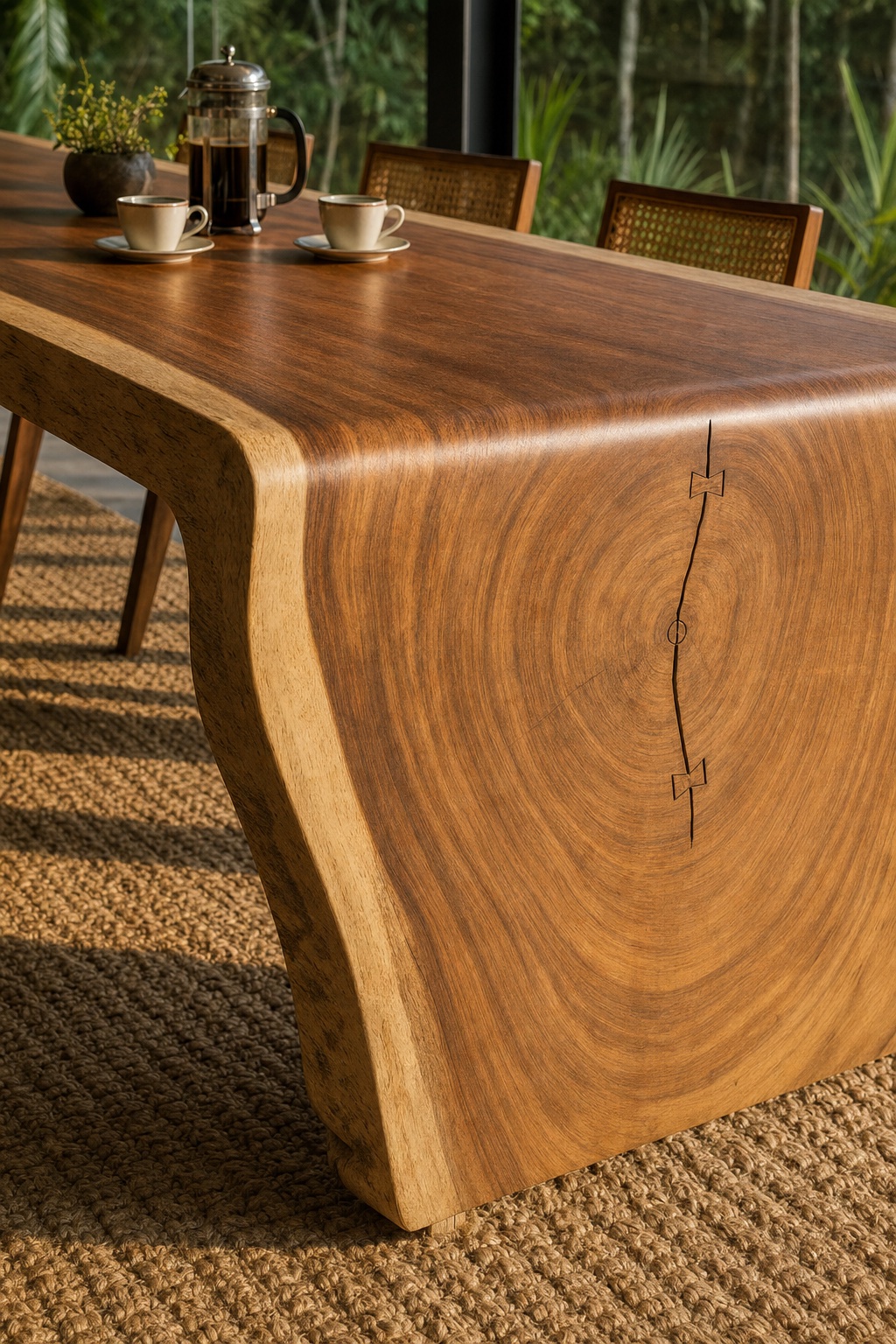
Guanacaste (Parota)
Enterolobium cyclocarpum · warm golden brown · light for a hardwood · bold interlocked grain
Guanacaste wood — also called Parota — comes from Enterolobium cyclocarpum, Costa Rica's national tree: a lightweight tropical hardwood with bold, swirling grain, cut in slabs wide enough to build an entire dining table from a single piece. The tree is the huge, umbrella-crowned landmark you see standing alone in Guanacaste pastures, and it gives the province — and this workshop's home — its name.
The heartwood is a warm golden brown, often streaked with darker chocolate lines, with a coarse, lively figure that moves across the slab like water. It is one of the lightest true hardwoods we work with, and once properly dried it is remarkably stable — low shrinkage, little seasonal movement. That combination of width, figure, and light weight is why it is our first choice for single-slab dining tables, large doors that would be too heavy in a denser wood, and carved sculptural pieces.
The honest trade-off: Guanacaste is softer than teak — roughly half as hard on the standard Janka scale — so a daily-use surface will collect small marks over the years. The heartwood resists decay and insects well, and a thick solid top can always be re-sanded, but if you want a surface that shrugs off everything, read on.
Teak
Tectona grandis · golden honey · dense and oily · straight, even grain
Teak (Tectona grandis) is not native to Costa Rica, but it has been grown in plantations here — much of it in Guanacaste province — for decades. The wood is golden honey in color, straight and even in grain, and naturally rich in oils that make it the most weather- and moisture-resistant wood in this comparison. It is dense, roughly twice as hard as Guanacaste, and famously stable through humidity swings.
We reach for teak when a piece will live hard: pieces exposed to weather, covered terraces, and surfaces that must stay flat and tight through wet and dry season. Its natural oils mean it can be left to weather to a silver grey outdoors, or kept golden with minimal care.
The trade-offs are real. Plantation teak grows in straight, comparatively narrow trunks — so a wide teak top is a glued panel of boards, never one dramatic slab. And its calm, even grain is a quieter voice: beautiful, but without the wild figure that makes a Guanacaste or Cenizaro slab a one-of-a-kind piece. Teak is the engineer's choice; the other two are the sculptor's.
Cenizaro (Monkey Pod)
Samanea saman · rich chocolate brown · medium density · high-contrast live edge
Cenizaro (Samanea saman), known abroad as Monkey Pod or rain tree, is the darkest and most dramatic of the three. The heartwood is a rich chocolate brown shot with golden streaks, and it meets the pale cream sapwood in a sharp line — which is why a live-edge Cenizaro slab has that striking dark-center, light-edge contrast people fall in love with.
Like Guanacaste, the tree grows broad — wide single slabs are possible — and the wood sits between the other two in hardness: tougher than Guanacaste underfoot and under forks, lighter work than teak. It takes a hand-rubbed finish beautifully, with a natural luster that deepens the color.
Its trade-off lives in the workshop more than in your home: the interlocked grain that produces the figure also tears easily under machine planing, so Cenizaro demands slow passes and hand finishing. We consider that a fair price. For a client, the practical note is moderate seasonal movement — solved by proper drying, which is where every one of our pieces starts.
How we dry wood in Tilarán
None of these comparisons matter if the wood is wet. A slab that goes from a sawmill into a coastal living room will move, check, and crack — no finish can stop it. Every slab we build with is sustainably sourced and kiln-dried in-house, in our own kiln in Tilarán, down to 8–12% humidity, and treated against pests before it enters the shop. Thick slabs rest until they are fully acclimated; only then do they become furniture. It is the least visible step in the process and the one that decides whether a table is still flat in twenty years. We never build with veneer or MDF — every piece is solid hardwood, through and through.
So which wood should you choose?
If you want one continuous slab with bold figure — a table with a story in its grain — choose Guanacaste for warm golden tones and lighter weight, or Cenizaro for deep chocolate color and high contrast at the live edge. If the piece will live outdoors or you want maximum hardness and don't need single-slab drama, teak earns its reputation. In practice, many homes we furnish use all three: a Guanacaste dining table, Cenizaro coffee table, teak outside on the terrace, and Laurel or Cedar in the kitchen cabinetry.
There is no wrong answer among the three — only a wrong match between wood and use. That match is what the first conversation of every commission is for.
If the piece you have in mind is a table, the next question is the slab itself — how thick, how long, and what carries it. That is covered in the guide to live-edge dining tables in Costa Rica.