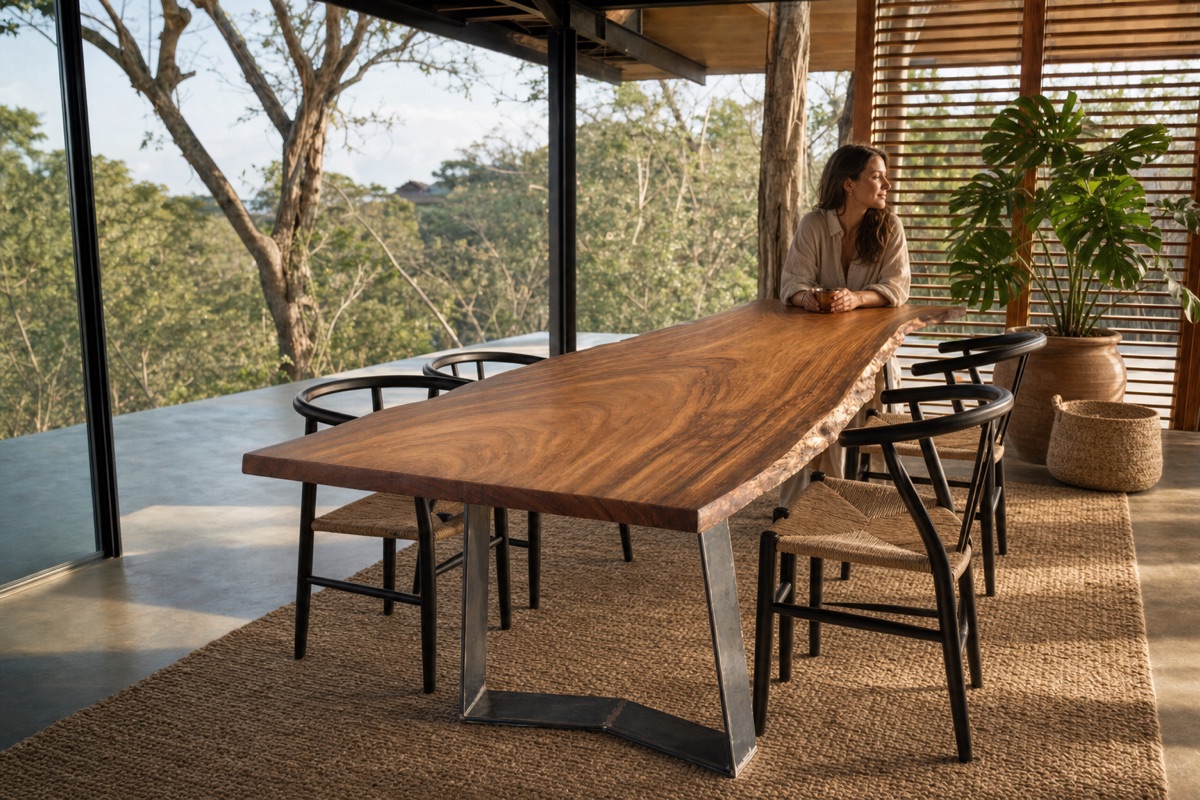
What "live edge" actually means
A live-edge top keeps the natural outer profile of the tree instead of being cut straight. The slab is milled from the trunk, the bark is removed, and the undulating line where the wood once met its bark is cleaned, stabilised, and finished as part of the piece. Nothing is added — the shape of the edge is simply the shape that tree grew.
Two things follow from that. The first is that no two tables are the same, because no two trunks are. The second is less obvious: a live edge only reads as honest if the top is genuinely one slab. A tabletop glued up from narrow boards with a wavy edge cut into the outer two is a different object, and it will never have the continuous grain that runs the length of a real slab. Every dining table we build is solid hardwood, through and through — never veneer, never MDF.
Choosing the slab
In Costa Rica two woods dominate single-slab dining tables, and both grow broad enough to yield a whole tabletop from one piece. Guanacaste, also called Parota, is warm golden brown with bold interlocked grain that moves across the slab like water, and it is light for a hardwood. Cenizaro, known abroad as Monkey Pod, is darker — rich chocolate heartwood shot with gold, meeting a pale cream sapwood in a sharp line, which is what gives a Cenizaro live edge its striking contrast. Cenizaro is also harder underfoot and under forks. We cover the differences, including the honest trade-offs, in the guide to choosing wood.
In practice the wood is only half the decision. The other half is the individual slab, and that is where the real work is. Length, width, the run of the two live edges, the figure in the grain, where the natural cracks sit — these vary tree to tree, and they decide what the table can be. For the four-metre La Paz we need a log wide enough to seat six down each side and large enough to yield matching waterfall legs from the same timber; finding it is the slowest part of the commission. Clients are welcome to choose their own slab from our inventory in Tilarán, and most who visit the workshop do.
How thick the top should be
Our dining slabs run about 3 to 3.5 inches thick. Nosara is a 3-inch Guanacaste slab; La Paz is 3.5. That thickness is structural before it is visual: it lets a long top carry its own span without sagging, and it leaves enough material that the surface can be re-sanded decades from now and come back new. It also matters to the eye — at three inches the live edge reads as a solid mass of wood, which is the whole point. A thin top with a wavy edge looks like a picture of a slab rather than the thing itself.
Width is not ours to choose. A slab is as wide as the tree was, which is why La Paz is 150 centimetres across and another table from another log will not be. If you need an exact width, we will tell you honestly whether a slab can give it before anything is promised.
The base carries the design
A slab needs something under it, and that decision changes the character of the room more than most people expect. Three approaches cover almost everything we build.
Steel
A hand-forged steel base disappears under the wood. Nosara sits on a slim V of quarter-inch raw steel, left in its mill finish and sealed, so a heavy slab appears to float above a thin dark line. Warm over industrial, and visually the lightest option — good in glass-walled rooms where you do not want to add mass.
A waterfall in the same wood
The most demanding option: the legs are milled from the same log as the top and grain-matched, so the figure runs the length of the table and turns straight down at both ends. On La Paz the edges are curved to simulate the bend, and the table reads as one continuous fall of wood from surface to floor — no visible base, no hardware in sight. It costs more because it needs a much larger log, and because the matching has to be right the first time.
A wood base
Turned or carved legs and sculptural trestles in solid hardwood sit between the two — warmer than steel, less demanding of the log than a waterfall. This is usually where a design goes when the budget matters and the top is the star.
Sizing the table to your room
Start from how you host, not from the room. We size a table at roughly 60 to 65 centimetres — about 24 to 26 inches — of edge per person, which is the space a seated adult needs without touching elbows. Count along both long sides, then add the two ends if you intend to use them.
| Table length | Seats along the sides | With both ends |
|---|---|---|
| 1.8 m · 6 ft | 4 | 6 |
| 2.4 m · 8 ft | 6 | 8 |
| 3.0 m · 10 ft | 8 | 10 |
| 4.0 m · 13 ft | 12 | 12 |
Nosara seats eight to ten. La Paz, at four metres, seats twelve with six down each side — wide enough that the ends are not needed.
Then leave room to move. Allow about a metre of clear floor behind each seating side so chairs can pull out and someone can walk past a seated guest. If you are furnishing a new build, the honest moment to have this conversation is when your interior walls are up and the real dimensions exist — early enough to size the table to the room rather than the other way round.
Living with solid wood in a tropical climate
This is the question we get most from clients building on the coast, and the answer is decided long before the table reaches the house. A slab that goes from a sawmill into a humid living room will move, check, and crack, and no finish will stop it. Every slab we build with is sustainably sourced and kiln-dried in our own kiln in Tilarán down to 8–12% humidity, treated against pests, and left to acclimate before it becomes furniture. It is the least visible step in the process and the one that decides whether a table is still flat in twenty years.
Cracks that were already in the slab are a different matter — they are part of the tree's history, and we keep them. They are stabilised with hand-fitted butterfly keys that hold the fissure closed and read as part of the design rather than a repair.
Once the table is yours, the care is simple and mostly about placement: keep it where temperature and humidity stay reasonably stable and out of direct sunlight — that single habit preserves more than any product. Clean with a dry microfibre cloth, or one slightly dampened with water, and use mild hand soap diluted in water for stubborn spots. Skip harsh detergents, oils, and commercial waxes; they do more harm than good on our finish. Full instructions and the one-year warranty are on the warranty and care page.
What a live-edge dining table costs
Recent individual commissions from our workshop ranged from about ₡800,000 to ₡4,700,000 plus 13% IVA — roughly $1,500 to $9,000 — depending on design, wood, and scale. Dining tables sit toward the upper part of that range, because they need the largest and rarest material: a wide single slab of figured Guanacaste is premium wood, and a waterfall base needs a log big enough to yield the legs as well as the top.
The levers that move the number are the ones above — the slab, the base, and the length. There is no fixed price list; every table is designed to order, and we design to the budget you name in the first conversation. The guide to commissioning walks through the full process, what a written quote contains, and how IVA and shipping are itemised.
How long one takes
Most dining table commissions take eight to sixteen weeks, depending on slab selection and drying — longer than the six to eight weeks a smaller piece needs, because finding the right log is genuinely the slow part and we will not rush a slab out of the kiln to meet a date. We send progress photos from the workshop along the way. We deliver and place the table ourselves across Costa Rica — Nosara, Tamarindo, Papagayo, Playas del Coco, Santa Teresa, Sámara and the Central Valley — and crate for international shipping, where the wood travels well precisely because it left here fully dried.
If you want to see the work before you decide, the dining tables we have built are the clearest answer to most of these questions.